Surveillance, Rights and Urban Space: Lessons from MozFest 2025

Our session at MozFest 2025 took place on a Sunday morning at 9 a.m. – a somewhat tricky slot at such a busy event where activities last well into the night. But, despite the early hour, our room slowly filled in with participants eager to engage with yet another issue straddling technology and politics: how surveillance shapes life in our cities, and who is most affected by it.
Our session “The Watched City: Surveillance, Rights and Urban Space” was part of the Unlearning Harmful Tech Systems track. And that’s what we did: we asked participants to pause, question what has been normalised, and rethink the role digital systems play in organising urban life. To unlearn, we must let go of comforting assumptions – for example, that more data always means better outcomes or that technological solutions are inherently progressive. These assumptions are rendered visible when we centre lived experience, history, and power relations. Urban surveillance technologies are often introduced under the banners of safety, efficiency, and innovation, but in practice, they entrench existing inequalities and place disproportionate burdens on marginalised, and often racialised, people. One of our core aims in bringing our session to MozFest was to make that disconnect visible and to show that these technologies are neither neutral nor inevitable. We wanted to creating a space for participants to explore how – in their local contexts and globally – narratives of “smartness” and “efficiency” are used to obscure the harms such systems cause. We designed the session to encourage shared reflection, collective learning, and the co-development of strategies and principles for more inclusive and just urban technologies.
Inside the Session
We began with a quick association exercise, asking what comes to mind when participants hear the term “urban surveillance”. This opening anchored the session in participants’ diverse experiences across countries such as the US, Sweden, Japan, Belgium, and Costa Rica.
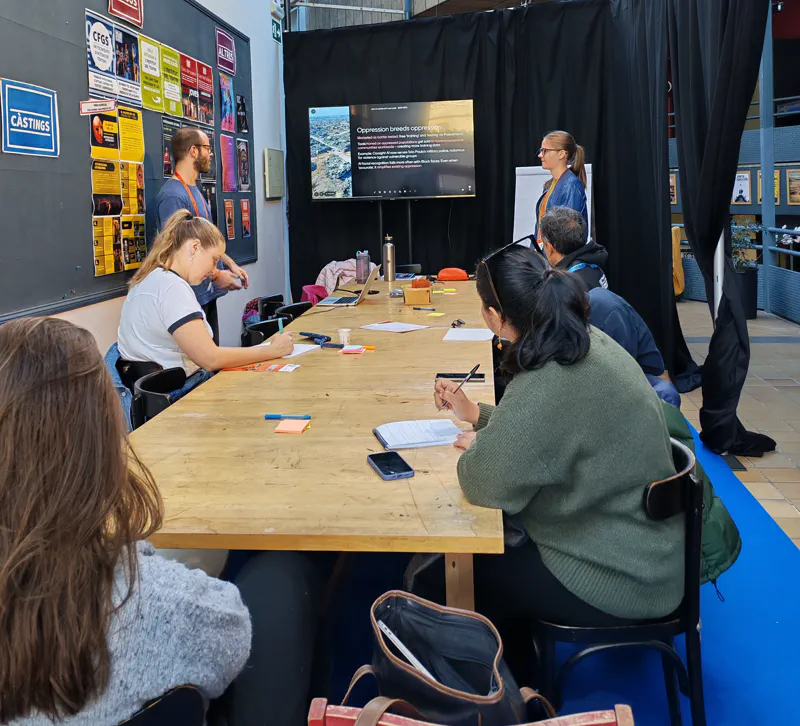
Two members of our team, Hanna Pishchyk and Julian Hauser, facilitated the session. Hanna opened by framing the discussion historically and politically. She invited participants to rethink surveillance not as a collection of isolated tools but as a way of organising the city itself. Surveillance shapes who is visible, who is legible, and who is treated as a risk. While some people move through cities with relative ease, others are routinely monitored, profiled, and controlled. Unlearning, in this context, meant challenging two deeply embedded ideas: that surveillance in cities is unavoidable, and that digital systems are disconnected from older histories of control. To illustrate this, Hanna traced how modern surveillance technologies grew out of colonial systems of classification and control. The historical pattern is clear: surveillance has always been about power.
Julian then elaborated how those very same dynamics persist in contemporary digital infrastructures and the global surveillance market. He stressed how surveillance technologies are developed, tested, and exported across borders – first trialled on one marginalised group, then turned on others elsewhere. Julian also drew attention to less visible forms of surveillance, such as Bluetooth tracking in shopping centres and public transport ticketing systems that are rarely seen as harmful, yet quietly shape behaviour. These examples pushed participants to see that surveillance is not always experienced as policing, espeically by those in more privileged positions. It is often folded into convenience, consumption, and routine, making it harder to notice and harder to resist.
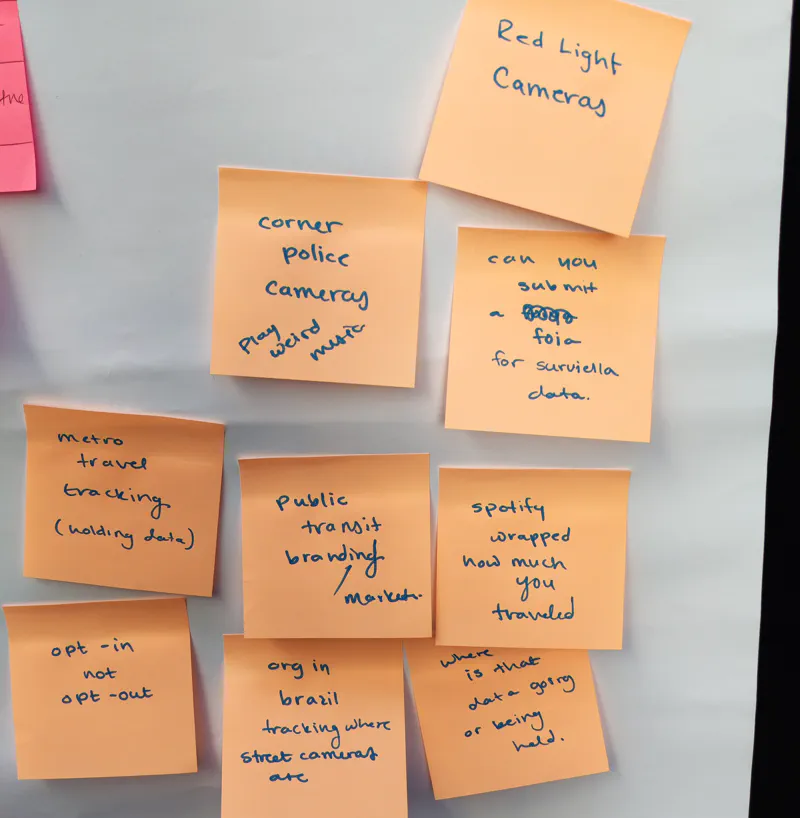
Participants then broke into small groups to reflect on their lived realities, guided by three prompts:
- Recognition: Which digital systems are shaping your city?
- Connection: What harms or inequalities do these systems produce, and who is most affected?
- Imagination: What acts of resistance and care, however small, could challenge these harms?
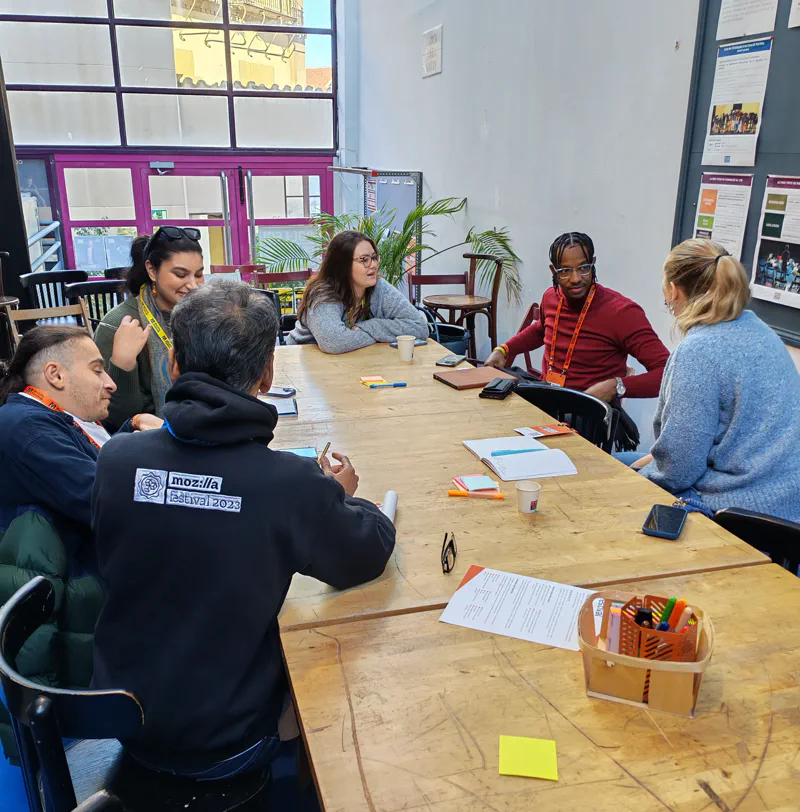
Here, the session shifted from analysis to collective sense-making. The discussion was lively and reflective. Several participants from the US spoke about immigration enforcement agencies using technology to target immigrants. Participants from other countries pointed to how everyday mobility already involves constant data collection and tracking. Two participants raised the idea of “peer surveillance,” noting how people increasingly monitor one another through apps and platforms, often without registering it as surveillance at all. One reflection stood out: a participant shared how knowing their child would be photographed and processed at a border made them question whether they wanted to travel to that country at all. Surveillance, in this case, did not just affect visibility – it shaped life decisions.
The discussion that followed was deeply engaging, and as our allotted time ran out, it was clear that much remained to explore. This had been our aim: the session was never meant to resolve the issue of urban surveillance, but to open it up, connect experiences, and spark conversations that continue beyond the room. That, in many ways, is what unlearning looks like – not replacing one answer with another, but making space to question what has been taken for granted.
Beyond the Session
MozFest 2025 was an important moment for us as an organisation. It gave us room to share our work, reconnect with friends and fellow activists in the digital rights community, and meet urbanists, artists, and activists working across other fields. Those conversations reinforced our conviction that communities, not corporations, should shape how technology enters their lives. We are grateful to MozFest for hosting that exchange, and to everyone who turned up early, spoke openly, and reminded us that the watched city can still be contested.